
Menu
Designing Priority Pass’s first AI trip assistant
Designing Priority Pass’s first AI trip assistant
Led design for Priority Pass’s first AI feature, defining how a conversational layer should behave inside an established travel ecosystem.
Redesign the pre-booking flow to move from a “lounge directory” to a “guaranteed access” service.
Redesign the pre-booking flow to move from a “lounge directory” to a “guaranteed access” service.

SCOPE/TEAM
Machine learning engineer, Product Manager, Developers
Product Manager,
Developers, Marketers
ROLE & CONTRIBUTIONS
Product strategy, Interaction design, Agentic & conversational UX, AI behaviour patterns Prototyping with AI
TIMELINE
2 months
SCOPE/TEAM
Machine learning engineer, Product Manager, Developers
ROLE & CONTRIBUTIONS
Product strategy, Interaction design, Agentic & conversational UX, AI behaviour patterns Prototyping with AI
TIMELINE
2 months
TL;DR
Designed Priority Pass's first AI powered feature, turning trip creation from a form into a conversation. The assistant translates incomplete, natural language into reliable flight data, connects that journey to relevant airport experiences and saves it as a real trip inside the existing Trips feature.
Defined an interaction model pairing conversation with a persistent structured trip state, so members always saw what the assistant had understood.
Established reusable AI behaviour patterns for uncertainty, correction, progress and limitation, forming the basis of an AI toolkit in the design system.
Prototyped behaviour instead of screens in Claude Code, pressure testing branching and recovery scenarios before build.
TL;DR
Designed Priority Pass's first AI powered feature, turning trip creation from a form into a conversation. The assistant translates incomplete, natural language into reliable flight data, connects that journey to relevant airport experiences and saves it as a real trip inside the existing Trips feature.
Defined an interaction model pairing conversation with a persistent structured trip state, so members always saw what the assistant had understood.
Established reusable AI behaviour patterns for uncertainty, correction, progress and limitation, forming the basis of an AI toolkit in the design system.
Prototyped behaviour instead of screens in Claude Code, pressure testing branching and recovery scenarios before build.
SOLUTION
Here are some of the key insights

Built trips through flexible, agentic flows
The assistant let members describe their trip naturally, then reused familiar Priority Pass components to guide them through flight selection, review and trip creation.

Visible system progress
The assistant showed what had already been confirmed and what it was still working on, such as creating the trip or checking entitlements.
SOLUTION
Here are some of the key insights
Built trips through flexible, agentic flows
The assistant let members describe their trip naturally, then reused familiar Priority Pass components to guide them through flight selection, review and trip creation.
Visible system progress
The assistant showed what had already been confirmed and what it was still working on, such as creating the trip or checking entitlements.
CONTEXT
Priority Pass members needs hadn’t changed. Expectations had.
Before a trip, members repeatedly needed to understand:
what their membership included
which airport experiences were relevant to their journey
what they could access at each stage of the trip
That information existed across different parts of the product.
AI introduced a new interaction model: express intent first, then let the product assemble the relevant journey around it.
Before
Trips → Airport → Experience → Membership → Access
With assistant
“I’m flying through Heathrow next week. What can I access?”
CONTEXT
Priority Pass members needs hadn’t changed. Expectations had.
Before a trip, members repeatedly needed to understand:
what their membership included
which airport experiences were relevant to their journey
what they could access at each stage of the trip
That information existed across different parts of the product.
AI introduced a new interaction model: express intent first, then let the product assemble the relevant journey around it.
Before
Trips → Airport → Experience → Membership → Access
With assistant
“I’m flying through Heathrow next week. What can I access?”
THE OPPORTUNITY
How might we make a flexible AI interaction feel as dependable as the rest of the product?
AI responses won’t always look the same.
The design challenge was to make the experience predictable even when the content wasn’t.
Users should still know:
where to look
how to read it
what to do next
The opportunity was to combine the flexibility of an agentic flow with the familiarity of the existing product.

THE OPPORTUNITY
How might we make a flexible AI interaction feel as dependable as the rest of the product?
AI responses won’t always look the same.
The design challenge was to make the experience predictable even when the content wasn’t.
Users should still know:
where to look
how to read it
what to do next
The opportunity was to combine the flexibility of an agentic flow with the familiarity of the existing product.
Design approach
Designing patterns around user intent
The assistant could generate different content depending on the situation.
My role was to define familiar response patterns based on the user’s inferred goal, so the experience remained easy to scan and act on.
I defined a set of behavioural patterns that made variable AI responses feel consistent:
How we lay it out
Info Structure
Format
Order
Hierarchy
How we speak
Tone of Voice
Stays calm throughout
Appropriately confident
How we help you act
Decision support
Options
Trade-offs
Next steps
Design approach
Designing patterns around user intent
The assistant could generate different content depending on the situation.
My role was to define familiar response patterns based on the user’s inferred goal, so the experience remained easy to scan and act on.
I defined a set of behavioural patterns that made variable AI responses feel consistent:
How we lay it out
Info Structure
Format
Order
Hierarchy
How we speak
Tone of Voice
Stays calm throughout
Appropriately confident
How we help you act
Decision support
Options
Trade-offs
Next steps
OUTPUT
Designing patterns around user intent

“What does my membership include?”
Main user goal
Comprehension
STRUCTURE
Information-led
TONE
Calm & Direct
DECISION SUPPORT
Light
- clarify
- summarize
- follow-up question

"I'm flying from London to New York next Tuesday. What can I access at the airport?"
Main user goal
Decision-making
STRUCTURE
Information-led
TONE
Calm & Direct
DECISION SUPPORT
Light
- clarify
- summarize
- follow-up question
OUTPUT
Designing patterns around user intent
“What does my membership include?”
Main user goal
Comprehension
STRUCTURE
Information-led
TONE
Calm & Direct
DECISION SUPPORT
Light
- clarify
- summarize
- follow-up question
"I'm flying from London to New York next Tuesday. What can I access at the airport?"
Main user goal
Decision-making
STRUCTURE
Information-led
TONE
Calm & Direct
DECISION SUPPORT
Light
- clarify
- summarize
- follow-up question
Key decisions and trade-offs
How I refined the experience

Design beyond MVP without expanding MVP
Multi-city travel was not part of the initial release.
I still designed the underlying card and flight-leg model to support it later, so the MVP would not need to be restructured as soon as complexity increased.

Designing within constraints
I worked across product, engineering and design to keep the MVP moving without ignoring AI failure modes.
Happy paths first, risks mapped early: core journeys moved forward while key failure states were captured in parallel.
Dependencies surfaced early: layovers, missing flight data, duplicate trips, and added vs booked.
Constraints became design decisions: clearer boundaries, recovery and fallback behaviour.
Key decisions and trade-offs
How I refined the experience
Design beyond MVP without expanding MVP
Multi-city travel was not part of the initial release.
I still designed the underlying card and flight-leg model to support it later, so the MVP would not need to be restructured as soon as complexity increased.
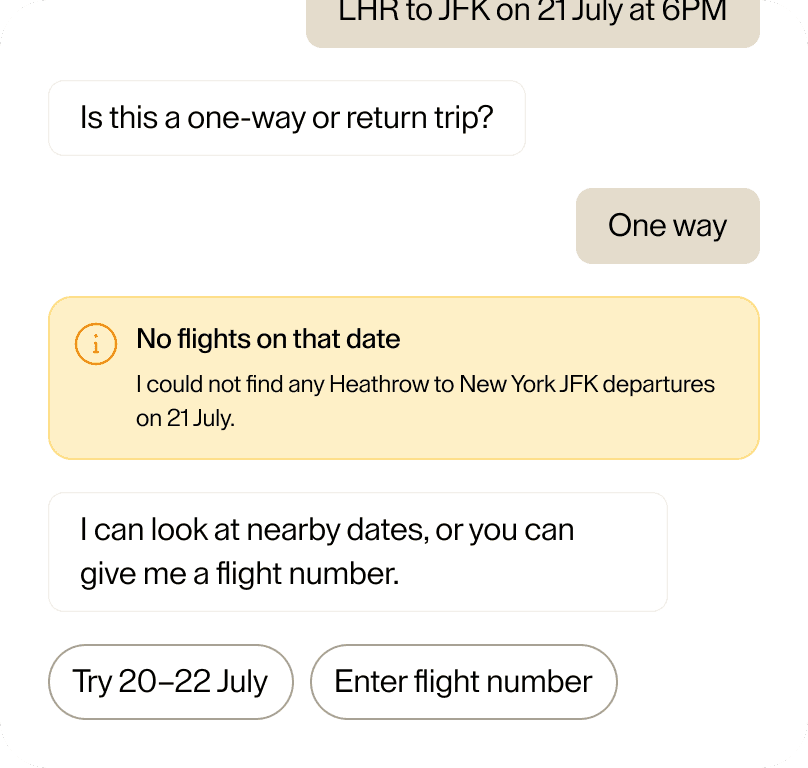
Designing within constraints
I worked across product, engineering and design to keep the MVP moving without ignoring AI failure modes.
Happy paths first, risks mapped early: core journeys moved forward while key failure states were captured in parallel.
Dependencies surfaced early: layovers, missing flight data, duplicate trips, and added vs booked.
Constraints became design decisions: clearer boundaries, recovery and fallback behaviour.
OUTCOMES
What the beta helped us validate
As a beta, the focus was less on proving commercial impact and more on validating whether the interaction model could support real trip-planning behaviour.
A viable conversational trip flow
Reusable AI interaction patterns
Clearer product and technical dependencies
OUTCOMES
What the beta helped us validate
As a beta, the focus was less on proving commercial impact and more on validating whether the interaction model could support real trip-planning behaviour.
A viable conversational trip flow
Reusable AI interaction patterns
Clearer product and technical dependencies
REFLECTION
My key takeaways and learnings
Design for recovery, not just success
AI flows are rarely perfectly linear. Correction, ambiguity and incomplete inputs needed to be treated as core interaction patterns rather than edge cases.
Constraints should shape the experience
Where data or capability was limited, the design needed to become clearer and more conservative instead of implying certainty the system could not support.
How AI changed my design workflow?
Prototyping behaviour, not just screens
I used Claude Code and Claude Design to explore edge cases, build branching prototypes and test changing trip states faster.
Less time producing states. More time refining logic, trade-offs and interaction quality.
REFLECTION
My key takeaways and learnings
Design for recovery, not just success
AI flows are rarely perfectly linear. Correction, ambiguity and incomplete inputs needed to be treated as core interaction patterns rather than edge cases.
Constraints should shape the experience
Where data or capability was limited, the design needed to become clearer and more conservative instead of implying certainty the system could not support.
How AI changed my design workflow?
Prototyping behaviour, not just screens
I used Claude Code and Claude Design to explore edge cases, build branching prototypes and test changing trip states faster.
Less time producing states. More time refining logic, trade-offs and interaction quality.