
Building and shipping CCD's first marketplace for carbon offsets
Redesign the pre-booking flow to move from a "lounge directory" to a "guaranteed access" service.
Team
Product Manager, Developers, Marketers
My Contributions
Research & Synthesis
Assumption mapping & risk assessment
Wireframes
User Testing
UI & Prototyping
TIMELINE
6 months
TL;DR
I was the sole designer on this project, owning the work end to end from research through to handoff and UAT. Over 7 months, I took CCD's carbon offset marketplace from a fragmented, spreadsheet-based process to a fully digital platform.
The biggest challenge wasn't the design itself it was navigating hard technical constraints that kept shifting what was actually buildable. I used assumption mapping to surface those risks early, ran both moderated and unmoderated user testing to validate direction, and pivoted the core approach mid-project when testing revealed the original flow wouldn't work.
2 partners onboarded within the first week of the product demo
Identified and resolved a critical usability risk before development, avoiding a costly rebuild
SOLUTION
Here are some of the key screens

A browsable project inventory
Before this, buyers were working off a shared Excel sheet. The new inventory keeps that familiar grid logic but turns it into a proper browsable experience with project imagery, key specs (price, country, volume, project type), and a VCS credibility tag front and center.
Project transparency pages
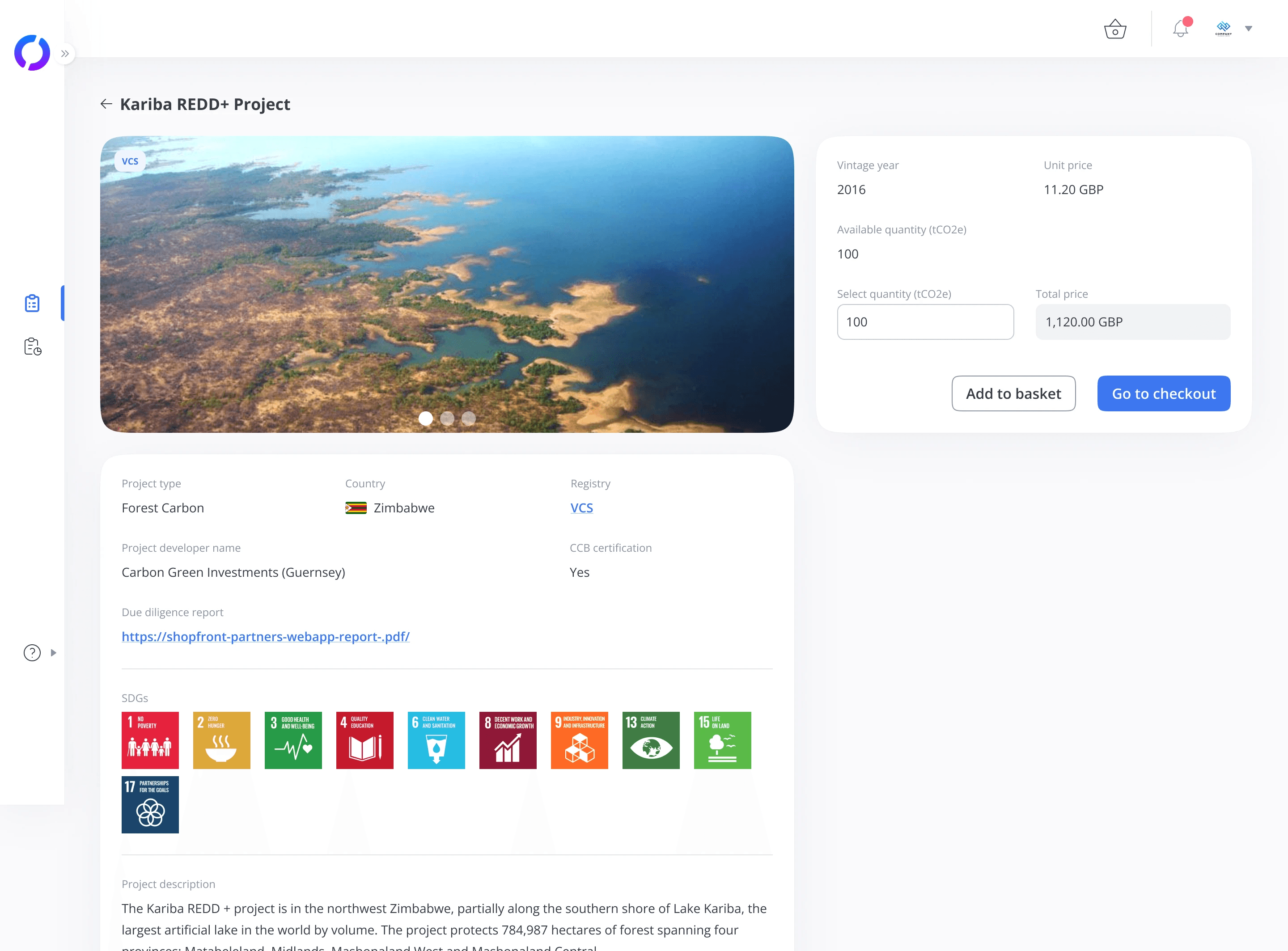
Each project now has a dedicated page with its full breakdown methodology, SDG alignment, supporting documentation, and imagery so buyers can do their due diligence without chasing the CCD team for information.

Order history
This reduced the back-and-forth for repeat buyers and gives the CCD team less to manually track on their end.
OVERVIEW
Helping enterprises act on their net-zero commitments
Climate Connect Digital provides a decarbonization-as-a-service platform for enterprises looking to source and retire high-quality carbon credits. The business had an established network of carbon projects and an existing client base — but the end-to-end buying process was entirely manual, fragmented across emails and spreadsheets.

PROBLEM
CCD had an established portfolio of carbon projects and an active client base — but no digital product. Every deal ran through email and spreadsheets, with the team manually involved at every step.
80%
spent significant time searching for projects and doing due diligence
60%
struggled to evaluate project quality without enough visual context
50%
were new to carbon offsetting and didn't know how to navigate the process
Insight based on focused interviews
We ran both moderated and unmoderated sessions. The unmoderated sessions gave us fast quantitative signal on usability; the moderated ones helped us understand what buyers were actually thinking as they moved through the flow.
Hypothesis
"Digitizing the service with a platform and API would credibly showcase the portfolio and give buyers a seamless way to source offsets without needing to go through the team each time."

DESIGN PROCESS
Explorations
We initially set out to cater for all approaches of buying carbon credits and mapped the design possibilities accordingly.
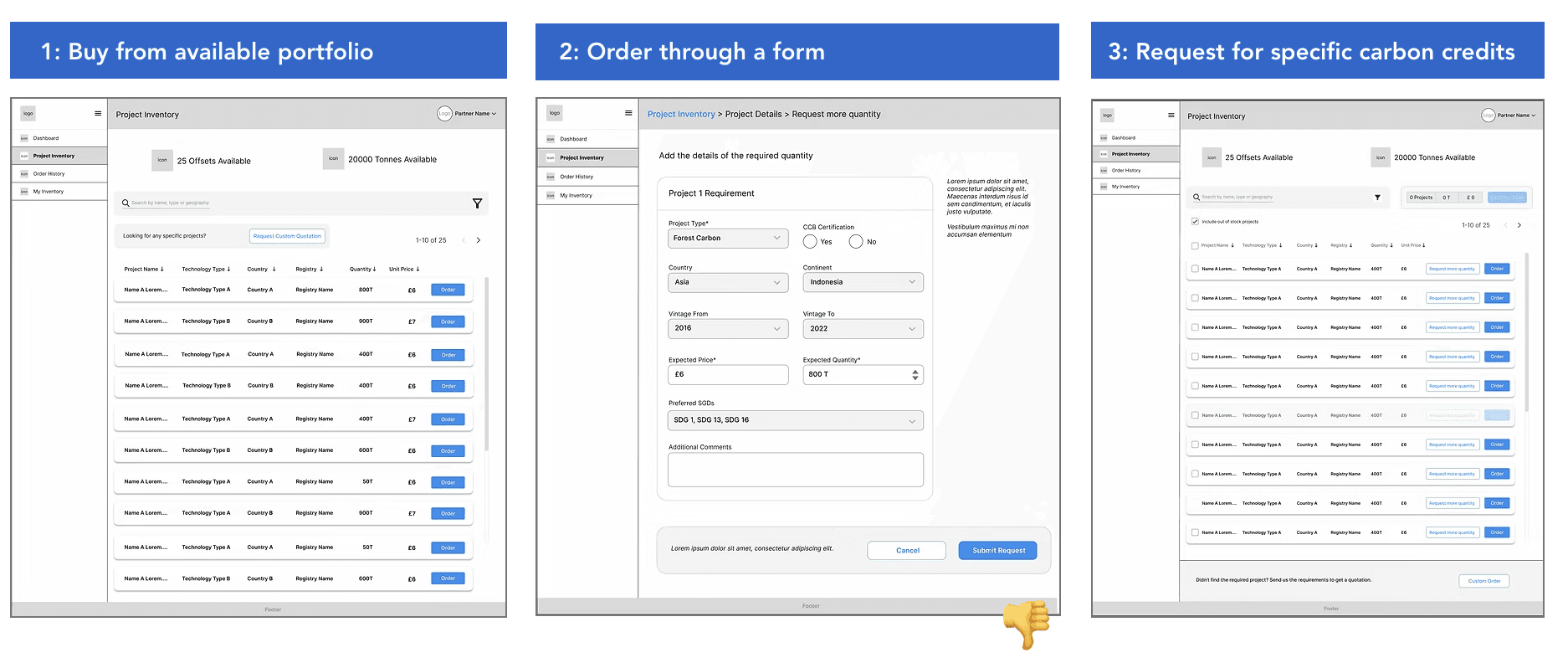
We quickly ruled out the form-based approach. Buyers have limited knowledge of the technical details of an order they're primarily focused on two things: price and quantity. A form that asked for more than that created unnecessary friction.
Buyers were also already familiar with the Excel sheet CCD used to share available projects. That told us the grid structure was worth keeping we just needed to make it better.
Assumption mapping
With two viable directions on the table, I ran a workshop with internal and external stakeholders to map our assumptions and assess how much risk each one carried.

From there, each assumption became a research question, and each research question pointed to a testing method. In our case, a mix of moderated and unmoderated interviews made the most sense — one to get quick usability data, the other to understand how users were actually reacting to the flow.
The Pivot
The data pointed to something we hadn't initially designed for. Buyers didn't just need a place to transact they needed enough context to trust the projects they were buying.
This reframe changed how we thought about the whole experience: what information lived on each project card, how individual project pages were structured, and how we balanced transparency with simplicity throughout the flo
We needed to treat the inventory as a marketing platform, not just a list.
Mapping Information architecture
Before moving into visual design, I mapped all the primary flows across the platform — from browsing the inventory through to checkout and order tracking. This became the reference point for the dev team and helped surface edge cases before they became build problems.

DESIGN SYSTEM
Since this was CCD's second product, I designed new components as needed and updated the existing design system to keep things scalable and consistent across the product suite.


OUTCOMES
The platform went from concept to shipped in 7 months one of the fastest turnarounds in CCD's history to date.
7 months from kickoff to launch
2 partners onboarded within the first week of the product demo
1 critical flow identified and rerouted before development, avoiding a costly rebuild
REFLECTION
My key takeaways and learnings!
Users don't always know what they need but they'll show you
The pivot came directly from watching users interact with the flow. Nobody told us the inventory needed to feel like a marketing platform. We saw it in how they hesitated, what they looked for, and what they couldn't find. That observation wouldn't have surfaced in a survey.
Stakeholder involvement isn't just good practice, it speeds things up
Alignment built over weeks of collaboration is much cheaper than alignment built in a final presentation.
Curious to know more?
This is just a small part of the project get in touch to know more.